Tree Risk Assessment Sydney
Advanced Tree Safety and Condition Assessments by AQF Level 5 Consulting Arborists
Has your tree developed a hollow, lost a major limb, started showing signs of decay or changed in a way that concerns you?
- AQF Level 5–9 arboricultural team
- QTRA and TRAQ qualified Consulting Arborists
- 32+ years' experience
- Advanced diagnostic testing in-house
- Evidence-based assessment and recommendations
- Fast-track assessments available
Concerned About the Safety of a Tree?
A Tree Risk Assessment examines the tree's condition, structural integrity and potential for tree or branch failure, together with what could be affected if failure occurred.
Arbor Express provides advanced Tree Risk Assessments throughout Sydney for homeowners, strata properties, schools, commercial properties and other sites where tree safety or structural condition needs to be properly understood.
Our first step is a detailed visual assessment by an experienced Consulting Arborist. Where visual assessment alone cannot provide enough information, we can investigate further using our own specialist diagnostic equipment and arborists, all in-house.
If you already know you want to remove a tree and need to determine the council approval or reporting pathway, see our Tree Removal Sydney service.
When Should a Tree Be Risk Assessed?
A Tree Risk Assessment may be appropriate when something about a tree's condition or behaviour raises concern, particularly where the significance of the problem is not immediately clear. Common reasons are listed.
A tree can appear healthy in the crown while still containing significant structural defects. Equally, the presence of a hollow, wound or unusual growth does not automatically mean that a tree is unsafe. The purpose of the assessment is to understand what those signs mean for the particular tree.
- Large hollows or cavities
- Visible decay or fungal activity
- Failed or falling limbs
- Cracks or splits in trunks and major branches
- Unusual swelling, ribs or changes in tree form
- Previous branch or structural failure
- Dead or declining sections of canopy
- Root damage or disturbance
- Movement or changes around the root plate
- Trees close to homes, buildings, roads, playgrounds or frequently occupied areas
Reading the Tree, Then Looking Deeper
Trees respond to injury and mechanical loading over many years, and those responses can leave visible clues in their form.
Research into modern tree biology and biomechanics, including Alex Shigo's work on compartmentalisation and Claus Mattheck's work on tree biomechanics and the "body language of trees", has influenced how arborists interpret wounds, hollows, cracks, adaptive growth and changes in tree form.
A bulge, rib or unusual growth pattern can indicate that a tree has responded to localised mechanical stress or previous damage. An old wound may become enclosed by new growth while altered or decayed wood remains internally.
These external signs are important, but they do not always tell us the extent or significance of what is occurring inside the tree. When the visual evidence leaves an important question unanswered, we can investigate further.
When Visual Assessment Isn't Enough
Not every Tree Risk Assessment requires specialist testing. The Consulting Arborist first assesses the tree visually and determines whether further investigation would provide meaningful additional information. Where uncertainty remains, Arbor Express can investigate the tree from three perspectives.
Because these services are provided in-house, the diagnostic findings can be considered together with the original arboricultural assessment rather than treated as separate, disconnected investigations.
- Inside the tree: internal decay, hollows and changes in wood condition.
- Below ground: roots, root damage, root collar condition and significant root location.
- Above ground level: branch unions, cavities, cracks, decay and other defects that cannot be adequately assessed from the ground.
Advanced Tree Diagnostics, All In-House
Resistograph Testing
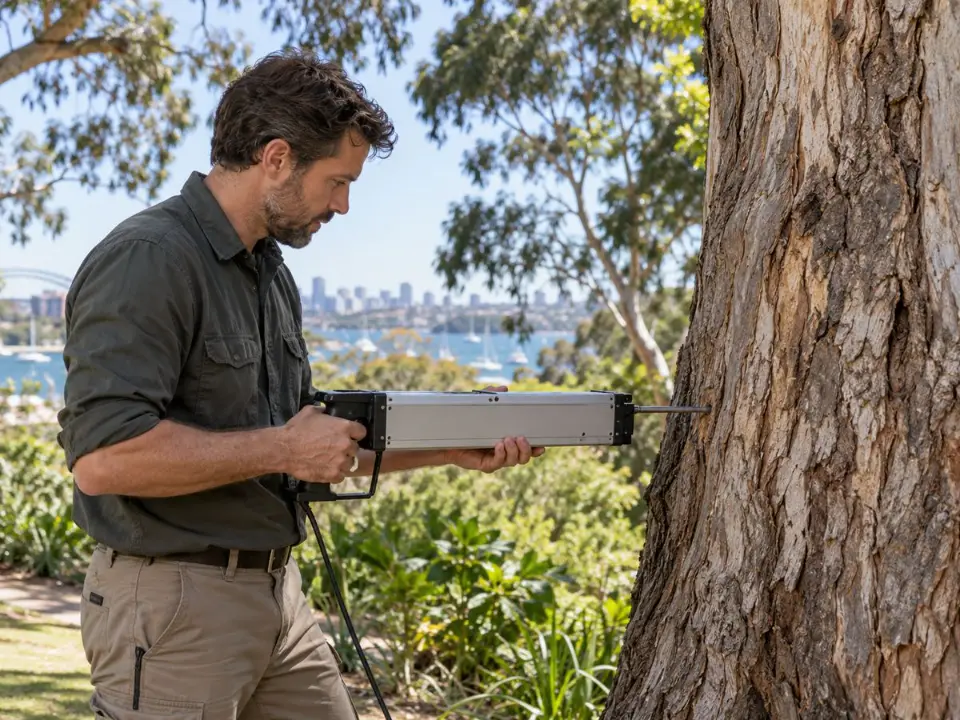
Where internal decay or hollowing is suspected, Resistograph testing measures drilling resistance through a narrow path in the wood. The results help the Consulting Arborist identify changes in wood resistance, areas of suspected decay and cavities that cannot be adequately understood from external inspection alone.
Hollow and Decay Assessment
A hollow tree is not automatically a dangerous tree. We assess visible hollows and cavities together with the tree's form, structural characteristics, adaptive growth and other relevant evidence, with diagnostic testing where necessary. The significance of a hollow is interpreted in the context of the whole tree, not simply because a cavity exists.
Tree Root Investigation
Where concerns relate to roots or below-ground conditions, further investigation may be required to determine the location and condition of significant roots, particularly where roots may have been damaged, severed or disturbed.
AirSpade Investigation
Our in-house AirSpade equipment uses compressed air to carefully expose roots and the root collar with substantially less disturbance than conventional mechanical excavation, allowing the Consulting Arborist to directly examine selected below-ground areas.
Aerial Tree Inspection
Some structural features cannot be adequately examined from ground level. Where required, aerial inspection allows closer assessment of upper-canopy features such as major branch unions, cavities, cracks, wounds, decay and previous limb failures, with findings incorporated into the overall assessment.
From Evidence to a Management Decision
An advanced assessment brings the different pieces of evidence together.
The objective is not to find a reason to remove the tree. It is to obtain sufficient evidence to make a proportionate recommendation based on the tree's actual condition, surrounding targets and identified risk.
- 1Visual assessment: tree form, vitality, defects, wounds, adaptive growth and fungal indicators.
- 2Advanced investigation, where required: internal wood (Resistograph and hollow/decay investigation), below ground (AirSpade and root investigation) and upper tree (aerial inspection).
- 3Arboricultural interpretation: AQF Level 5–9 expertise, QTRA/TRAQ capability and professional arboricultural judgement.
- 4Management recommendation: retain, monitor, prune, further investigate, manage targets or remove.
What Might We Recommend?
Depending on the assessment findings, recommendations may include the options listed.
Where removal is recommended and council approval or supporting documentation is required, we can explain the appropriate next step.
- Retention with no immediate work
- Periodic monitoring or reassessment
- Targeted pruning
- Management of the area around the tree
- Further diagnostic investigation
- Remedial works where appropriate
- Tree removal where the identified risk cannot reasonably be managed
Which Tree Assessment Do You Need?
Why Choose Arbor Express?
Advanced Tree Risk Assessment requires more than owning diagnostic equipment. The findings from each investigation need to be interpreted in the context of the tree as a complete living structure. Arbor Express combines experienced Consulting Arborists with specialist diagnostic capability in-house, so we can move from visual assessment to further investigation where required without referring parts of the assessment to outside providers.
- AQF Level 5–9 arboricultural team
- QTRA and TRAQ qualified Consulting Arborists
- 32+ years' arboricultural experience
- In-house Resistograph testing
- In-house AirSpade root investigation
- Hollow and decay assessment
- Aerial tree inspection capability
- Evidence-based management recommendations
Has a Tree Suddenly Changed?
Contact us and explain what has occurred. We can prioritise time-sensitive Tree Risk Assessments where inspection availability allows.
0494 077 630Frequently Asked Questions
No. Many trees can be appropriately assessed through visual inspection and professional arboricultural assessment. Specialist investigation is used where it can provide meaningful additional evidence about an identified concern or uncertainty.
Not automatically. A hollow or cavity is one piece of evidence. Its significance depends on factors such as its location and extent, the tree's structure, surrounding wood, loading, other defects and what could be affected if failure occurred.
Yes. Where internal decay is suspected and further investigation is appropriate, our in-house Resistograph testing can provide additional information about wood resistance, suspected decay and cavities along the tested path.
Yes. We provide root investigation, including AirSpade excavation where appropriate, to expose selected roots and below-ground areas for direct arboricultural assessment.
Yes. Where a defect cannot be adequately assessed from ground level, aerial inspection can provide closer access to branch unions, cavities, cracks, decay and other upper-tree features.
No. Recommendations may include retention, monitoring, pruning, management of surrounding targets, further investigation or removal. The recommendation should reflect the evidence and assessed risk rather than a predetermined outcome.
Contact us and explain what has occurred. We can prioritise time-sensitive Tree Risk Assessments where inspection availability allows.
Tree Risk Assessments Across Sydney and NSW
Arbor Express provides Tree Risk Assessments for residential, strata, commercial, educational and other properties throughout Greater Sydney and surrounding NSW regions.
Council requirements vary between areas. Where the assessment ultimately leads to proposed tree removal, we can also advise on the applicable council reporting or approval pathway.
What Our Clients Say
Concerned About the Safety of a Tree?
If a tree has developed decay, hollows, failed limbs, root problems or other structural concerns, we can assess what is visible and investigate further where the evidence requires it.