
Tree Removal in Canberra – What You Can and Can't Do
Understanding Tree Removal Requirements in Canberra
Tree removal in Canberra is regulated under the Urban Forest Act 2023 (ACT). Our local Level 5 Arborists prepare arborist reports for tree removal, hazardous trees, health and safety assessment and development approval across Canberra. Most trees on public land and many on private land are protected. Where removal is proposed, approval may be required and supported by clear arboricultural evidence, particularly where safety, structural failure or development impacts are involved.
- Local Level 5 Arborists
- 32+ years' experience
- Council-ready reports
- Aligned with the Urban Forest Act 2023 (ACT)
Need a Tree Removal Report for a Development Project?
Tree removal associated with development is assessed differently and often requires supporting arborist documentation.
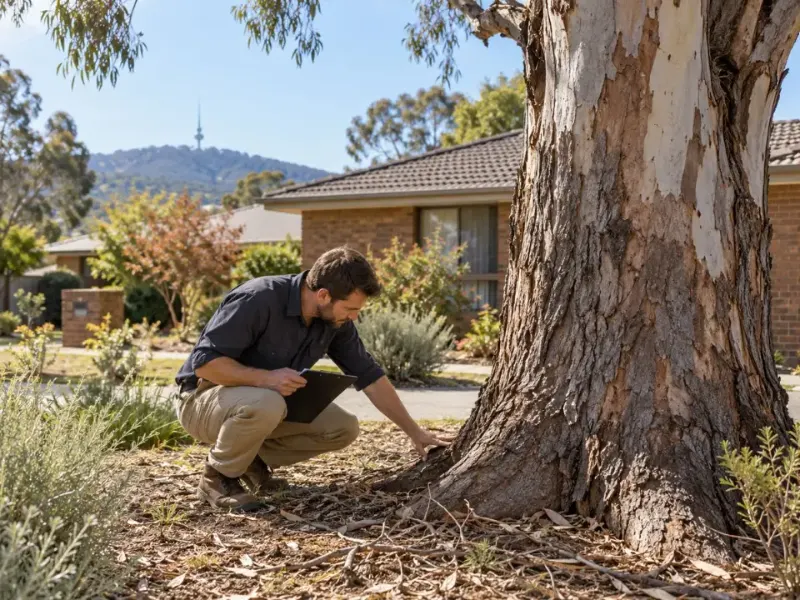
Can I Remove a Tree in Canberra?
Only if the tree is not protected or approval has been granted. In some cases, trees may be removed without approval where they are:
All trees on public land are protected and require approval. Where a tree meets protection criteria, approval is generally required before removal.
- Not protected under ACT criteria
- Dead or exempt from protection requirements
- Certain pest or exempt species
Proving a Tree Needs to Be Removed
Protected trees cannot be removed without evidence. A Level 5 arborist report is used to:
Removal must be demonstrated, not assumed.
- Assess structural integrity and stability
- Identify defects, decay and failure risk
- Evaluate the tree within its environment
- Determine whether it can be safely retained
- Provide clear, defensible justification for removal
How Risk and Failure Are Assessed
Tree failure risk is based on structural condition and site context. Assessment considers:
These indicators help determine how the tree is behaving structurally.
- Cracks, splits and weak unions
- Internal decay and hollowing
- Lean and root plate movement
- Previous failures or canopy imbalance
- Wind exposure and edge effect
Understanding the Body Language of Trees
Trees show visible responses to stress, loading and structural weakness. Using biomechanical principles developed by tree biomechanics researcher Claus Mattheck, assessment considers:
These visible structural responses help determine whether a tree remains stable or presents an elevated risk of failure.
- Load paths through the structure
- Compensatory growth and reaction wood
- Stress concentration points
- Whether the tree is adapting or failing
When Further Testing Is Required
Where condition is unclear, additional testing may be used, including:
These tools provide objective data to support the assessment.
- Resistograph testing for internal decay
- Root investigation for stability
- Aerial inspection for upper canopy defects
Does a Level 5 Arborist Report Carry Weight with Council?
Yes. A Level 5 arborist report provides the technical basis for decision-making. Council does not approve removal based on requests alone. Assessment typically relies on:
A well-prepared Level 5 report provides the information required to support a decision.
- Evidence of structural condition
- Clear identification of risk or decline
- Justification for why removal is necessary
- A report that is consistent, structured and defensible
Why Experience Matters
Experience directly affects the quality and reliability of the assessment. Some authorities request minimum experience levels because:
Experienced arborists provide consistent, defensible assessments aligned with real-world tree behaviour.
- Tree risk assessment is not purely visual
- Structural defects can be misinterpreted
- Poor reports can lead to incorrect recommendations
- Inconsistent reporting may create delays and requests for further information
Can I Remove a Dangerous Tree Immediately?
Only in genuine emergency situations. Immediate action may be justified where:
In most situations, evidence such as photographs or reports should still be retained, and retrospective justification may be required. If in doubt, document the condition and seek arborist advice before removal.
- The tree presents an imminent risk to life or property
- Failure is likely or already occurring
- The area cannot be made safe
How Do I Remove a Tree in Canberra?
The typical process includes:
Where development is involved, tree removal is generally assessed as part of the overall approval process.
- Confirm whether the tree is protected using ACTmapi
- Engage a Level 5 arborist
- Prepare supporting documentation where required
- Submit the relevant application
- Obtain approval before commencing works
Need Help Understanding Canberra Tree Rules?
Learn how protected trees, Tree Management Plans and development approvals work in the ACT.
Areas We Service Across Canberra
Our Level 5 Arborists provide arborist reports and development tree assessments throughout Canberra, servicing properties across all major Canberra districts.
We service all suburbs located within the following districts and surrounding areas across the ACT:
- Belconnen
- Gungahlin
- Inner North
- Inner South
- Molonglo Valley
- Tuggeranong
- Weston Creek
- Woden Valley
What Our Clients Say
Need Tree Removal Advice in Canberra?
Send us photos of the tree and we'll confirm whether approval is needed and what evidence will support it.