
Resistograph Testing Sydney
Internal Tree Decay Assessment and Diagnostic Testing
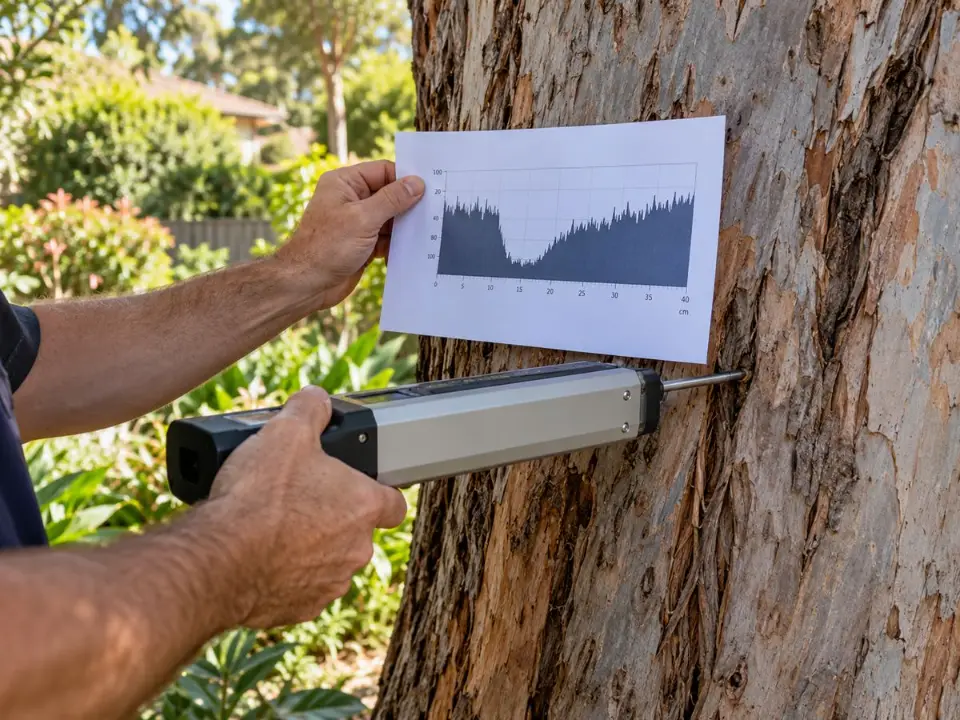
A Resistograph is a specialist diagnostic instrument used to measure the internal condition of wood, recording drilling resistance as a fine bit passes through the stem, roots or major branches.
- AQF Level 5, QTRA and TRAQ qualified Consulting Arborists
- 32+ years' experience
- In-house Resistograph equipment
- Minimally invasive diagnostic testing
- Fast-track service available
Need to Know What's Happening Inside a Tree?
Unlike a visual inspection, Resistograph testing provides objective, measurable information about internal decay, cavities and sound wood, a condition that often can't be assessed from the outside alone.
Arbor Express undertakes Resistograph testing throughout Sydney, carried out by AQF Level 5, QTRA and TRAQ qualified Consulting Arborists using our own in-house equipment.
When Is Resistograph Testing Recommended?
If a tree's external appearance doesn't give you a clear answer, Resistograph testing provides a specialist form of tree decay testing to investigate the internal wood condition.
- Hollow trees or suspected internal decay
- Trees showing fungal fruiting bodies
- Large veteran or heritage trees
- High-value trees where certainty matters
- Trees being retained near development
- Risk assessments requiring further evidence
What Can Resistograph Testing Determine?
Rather than relying solely on external symptoms, testing gives you objective evidence to support the decision that follows.
The results help determine whether the tree can reasonably be retained, requires monitoring or further assessment, or whether removal is supported by the internal condition identified.
- The extent of internal decay
- The thickness of remaining sound wood
- The presence and size of hollow cavities
- Internal defects not visible externally
- Residual wall thickness and decay location within the stem or major limbs
How Resistograph Testing Works
A Resistograph uses a very fine drill bit, leaving a minimal wound far smaller than an increment borer or exploratory drilling, to pass through the wood while recording resistance as it goes.
As the bit encounters sound wood, decay or a cavity, the resistance changes, and the instrument records this as a graph. That graph is then interpreted by a qualified arborist to build a picture of the tree's internal condition at that point. Depending on the tree and the concern being investigated, multiple test points may be taken around the stem or at different heights.
Compared with more invasive methods of investigating internal wood condition, Resistograph testing is minimally invasive and creates only a very small drilling wound.
When Visual Assessment Isn't Enough
External symptoms don't always reflect what's happening inside a tree, and relying on appearance alone can cut both ways: a healthy-looking tree can still carry significant internal decay, while a hollow tree can retain substantial structural strength depending on the extent and location of the cavity.
This is why a visual assessment alone can lead to the wrong call in either direction: recommending removal of a tree that's structurally sound, or retaining one that isn't. Resistograph testing closes that gap with objective data.
Resistograph Testing vs Tree Risk Assessment
Resistograph testing is commonly recommended as part of a broader Tree Risk Assessment, including where a tree has suddenly changed or appears hazardous and is being assessed as a priority inspection, where internal condition needs confirming rather than assuming.
Our Testing Process
- 1Consultation: we discuss the tree, the concern and what the testing needs to confirm.
- 2Visual assessment: an initial visual assessment to inform where testing is likely to add value and select appropriate test points.
- 3Resistograph testing: carried out using our in-house Resistograph equipment.
- 4Interpretation and report: resistance graphs are interpreted by a qualified Consulting Arborist, with clear recommendations based on the combined visual and internal findings.
Why Choose Arbor Express?
- AQF Level 5, QTRA and TRAQ qualified Consulting Arborists
- 32+ years' arboricultural experience
- In-house Resistograph equipment
- Objective, evidence-based diagnostic findings
- Continuity into Tree Risk Assessment where a broader assessment is required
Need an Answer Quickly?
Fast-track service is available. Call us to discuss the tree and your timeframe.
0494 077 630Frequently Asked Questions
The wound left by a Resistograph is very fine, far smaller than an increment borer, and is minimal compared with the value of the information it provides.
Yes. Resistograph testing records changes in drilling resistance that can help identify areas of reduced wood density, internal decay and cavities. Results are interpreted by the Consulting Arborist alongside the tree's external condition and other assessment findings.
No. Most trees can be properly assessed through visual inspection alone. Testing is recommended where there's a specific reason to investigate internal condition, such as suspected decay, a hollow, fungal activity, or a high-value tree where certainty matters.
Yes. Resistograph testing can provide evidence that a tree retains substantial sound wood, helping the Consulting Arborist make a more informed assessment about retention rather than recommending removal based on uncertainty alone.
Yes. Because it's minimally invasive, Resistograph testing is well suited to heritage and veteran trees, where retention is often the priority.
Resistograph Testing Across Sydney and NSW
Arbor Express provides Resistograph testing throughout Greater Sydney and surrounding NSW regions.
What Our Clients Say
Request Resistograph Testing
If a tree's external condition doesn't give you certainty, don't guess. Arrange Resistograph testing with an AQF Level 5 Consulting Arborist and get objective data on what's really happening inside the tree.